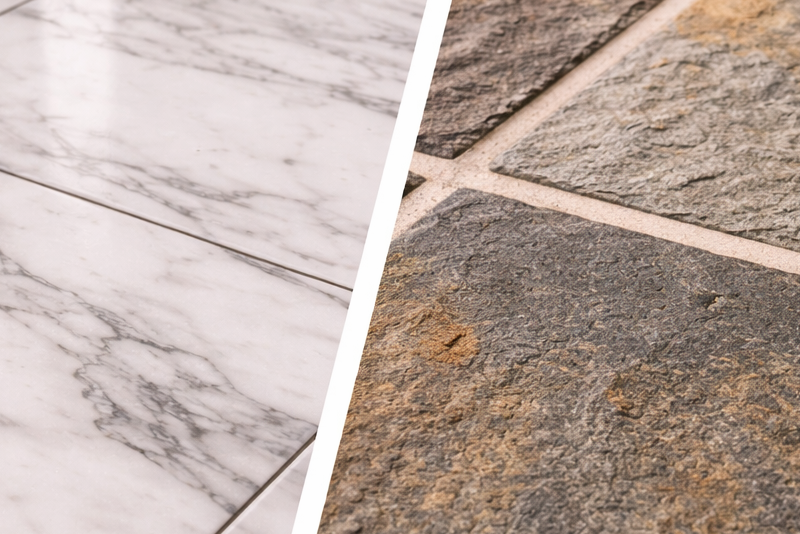
Natural Stone Tile Adhesive: How to Choose the Right System
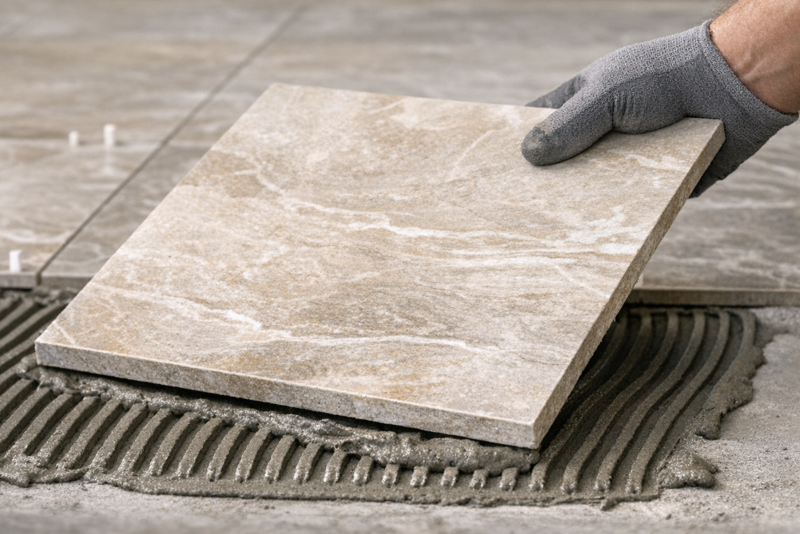
Natural stone gives walls and floors a premium look, but it also asks more from the installation system than many standard tiles.
That starts with the adhesive.
If the adhesive is not suited to the stone, the substrate or the site conditions, problems can show up quickly. Think staining, poor bonding, cracking, curling or visible shadowing behind the tile.
That is why choosing a natural stone tile adhesive should never be treated as a routine product decision. Marble, granite, limestone, sandstone and slate all behave differently, and each project brings its own technical demands.
A successful result depends on the full system, not only on the adhesive itself. Joint width, grout choice and finishing all play a role in the final performance and appearance. For a closer look at the finishing stage, see our guide to different types of grout for natural stone.
Why natural stone needs a specific adhesive approach
Natural stone is not one uniform material category.
Some stones are dense and heavy. Others are porous and more sensitive to moisture. Light-colored stone can be visually affected by the wrong adhesive, while heated floors and exterior areas introduce movement that the system must be able to handle.
That is why the best adhesive for one natural stone project may not be the best choice for another.
In practice, adhesive selection should always be based on:
- stone type
- stone color and porosity
- substrate condition
- wall or floor application
- interior or exterior use
- exposure to moisture, heat or movement
Choosing adhesive by stone type
Marble and light-colored natural stone
Marble is often selected for its clean and elegant appearance. That also means installation mistakes are easier to see.
For many marble projects, a white adhesive for natural stone is the safer option, especially where the stone is light-colored or slightly translucent. It helps reduce the risk of show-through and supports a cleaner final appearance.
Granite and other dense stone
Granite is usually denser and less absorbent than many other types of natural stone.
That can make it less visually sensitive in some applications, but it still requires the right bond strength and substrate compatibility. Larger formats and heavy floor installations place extra demands on the adhesive layer, so support and long-term stability matter.
Limestone and porous stone
Limestone and some sandstones are more porous by nature.
That makes adhesive selection more critical, because moisture and absorption can affect both the bond and the final appearance. In these cases, the system should be chosen with extra care rather than treated like a standard tile installation.
Slate
Slate can vary in structure, thickness and surface profile.
Where slate is used on floors or in exterior conditions, the adhesive should be able to cope with weight, movement and changing temperatures. A product that works well in a dry indoor setting may not be suitable in a tougher environment.
For more information, do not hesitate to contact us!
Choosing adhesive by substrate and installation area
The stone is only half of the specification. The substrate is just as important.
Porous and non-porous substrates
A porous substrate can draw moisture too quickly from the adhesive. A dense or smooth substrate may require stronger adhesion characteristics.
Existing tiles, renovation surfaces and challenging backgrounds should always be assessed properly before a product is chosen.
Natural stone tile adhesive for walls
Wall applications demand a reliable vertical bond.
This becomes especially important with heavy natural stone, where the adhesive needs strong initial grab and long-term holding power. The heavier the stone, the more important it becomes to avoid a generic one-size-fits-all approach.
Natural stone tile adhesive for floors
Floor applications require full support beneath the tile.
The adhesive must cure well, perform under load and help reduce the risk of stress points beneath the stone. This is particularly relevant with natural stone, where uneven support may contribute to cracking over time.
Exterior natural stone tile adhesive
Exterior applications are more demanding than indoor projects.
Rain, frost, heat and day-to-night temperature swings all create movement in the system. In these situations, an exterior natural stone tile adhesive often needs more flexibility than a product intended only for stable interior environments.
Natural stone tile adhesive for underfloor heating
Underfloor heating adds thermal movement to the floor build-up.
That makes flexibility a key part of the specification. A natural stone tile adhesive for underfloor heating should help the system absorb expansion and contraction without putting unnecessary stress on the stone.
Main types of natural stone tile adhesive
Flexible cement-based adhesive
A flexible cement-based system is a common choice for many natural stone applications.
It can offer a practical balance between performance, workability and broad suitability, especially where some movement in the system is expected.
White adhesive for marble and light stone
This is one of the most important subcategories in natural stone installation.
A white tile adhesive for marble is often preferred where appearance matters and the stone is vulnerable to visual distortion caused by darker materials behind it.
Rapid-setting adhesive
Some projects are driven by timing as much as by performance.
In those situations, a rapid-setting adhesive can help speed up the installation process and reduce downtime between stages.
Epoxy tile adhesive
An epoxy tile adhesive may be the right choice where high bond strength and durability are essential.
It is not the default answer for every project, but it can be a strong option in more demanding environments.
Polymer-modified adhesive
A polymer-modified adhesive is often selected where improved flexibility or stronger adhesion performance is needed.
That makes it particularly relevant for difficult substrates, movement-prone areas and projects with more demanding service conditions.
Common mistakes when choosing natural stone tile adhesive
Most problems do not come from the stone itself. They come from a specification that was too broad or too generic.
The most common mistakes include:
- choosing by price instead of suitability
- using the same adhesive for very different stone types
- ignoring stone color and appearance sensitivity
- overlooking the substrate
- underestimating movement in exterior areas or heated floors
- treating grout as a separate decision
That last point is often underestimated. In premium stone projects, adhesive and grout should be considered together. If appearance, joint width or long-term durability matter, it makes sense to review how to choose the right type of grout for natural stone before finalizing the full system.
A practical way to select the right adhesive
A simple selection process usually starts with a few direct questions.
1. What type of natural stone is being installed?
Marble, granite, limestone, sandstone and slate each behave differently.
2. Is the stone light-colored, porous or visually sensitive?
If yes, appearance-compatible systems such as white adhesive deserve closer attention.
3. Is it a wall or floor application?
Walls need strong vertical hold. Floors need full support and reliable curing beneath the tile.
4. Is the installation indoors, outdoors or above underfloor heating?
Movement and environmental exposure can change the specification completely.
5. What is the substrate like?
Porous, dense, smooth and renovation substrates all influence the adhesive choice.
6. Is speed important on site?
If installation time matters, rapid-setting systems may be worth considering.
7. Does grout also influence the final result?
If the answer is yes, the finishing stage should be reviewed at the same time. At that point, it is useful to compare the available options for grout for natural stone before approving the final specification.
Conclusion
There is no single best adhesive for every natural stone project.
The right solution depends on the stone, the substrate and the conditions the installation will face once it is in service. That may point to a white adhesive for natural stone, a flexible adhesive for natural stone tiles, an epoxy tile adhesive, or a system developed for exterior natural stone tile adhesive use or natural stone tile adhesive for underfloor heating.
Natural stone is a premium finish. It deserves a specification that treats it that way.
Find out more about adhesives for natural stone tiles by contacting us.
FAQ
1. What is the best adhesive for natural stone tiles?
There is no universal best product. The right adhesive depends on the stone type, substrate, location and expected movement or moisture exposure.
2. Do I need a special adhesive for marble?
Often, yes. Marble can be more sensitive to staining and visual shadowing, which is why white adhesive is often preferred.
3. Is white adhesive better for natural stone?
It is often better for light-colored or translucent natural stone where appearance matters.
4. Can I use the same adhesive for granite and limestone?
Not automatically. Granite is usually denser, while limestone is often more porous and can behave differently during installation.
5. Which adhesive is best for natural stone on underfloor heating?
A flexible adhesive is usually the better choice because it helps accommodate movement caused by heating and cooling cycles.
6. Can natural stone tile adhesive be used outdoors?
Yes, provided the adhesive is suitable for exterior conditions such as moisture, frost, heat and temperature fluctuation.
7. When should I consider epoxy tile adhesive?
Epoxy tile adhesive should be considered where very high bond strength and durability are required.
8. Is rapid-setting adhesive useful for natural stone?
Yes. It can help improve site efficiency and reduce waiting time between installation stages.
9. Does grout matter when choosing adhesive for natural stone?
Yes. Adhesive and grout should work together as part of one system, especially in high-end natural stone applications.
10. What is the most common mistake in natural stone tile installation?
Using an adhesive that is too generic for the stone, substrate or service conditions is one of the most common mistakes.
Discover more solutions for building & construction
What solution are you looking for?
We are specialized in the building and construction. Need the best products or advice? Then please leave your details and we will get in touch.